Puppy basics
Crate training a Toy Poodle puppy
Done kindly, a crate is not a cage. It is a safe den your Toy Poodle chooses to rest in, and it makes toilet training and calm downtime far easier from the first week home.
Nelson and Kim, Curious Tails · AVS licence AS24J00046 · 14 Jul 2026
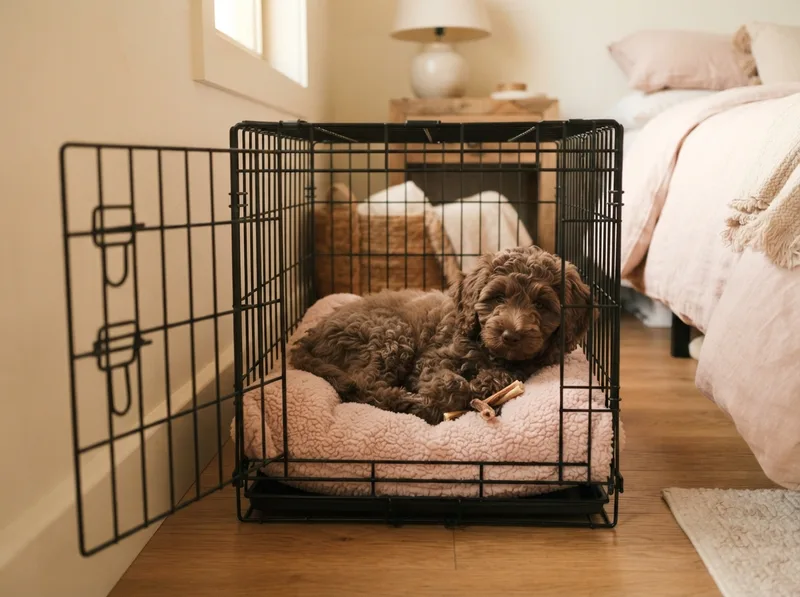
How do I crate train a Toy Poodle puppy?
Make the crate a good place, never a punishment. Feed meals inside, toss treats in, and let your puppy wander in and out with the door open at first. Build up to the door being shut for a few seconds, then minutes, always ending on a calm note. A Toy Poodle is a fast learner, so a kind, steady routine settles it quickly.
What size crate does a Toy Poodle puppy need?
A Toy Poodle's crate should be just big enough to stand up, turn around and lie down in, and no bigger. Extra room is not a kindness here, because a puppy with space to spare will pick one end to sleep in and the other as a toilet. Since a Toy Poodle grows to only around two to three kilos, a small or medium crate with a movable divider is ideal. You shrink the space while the puppy is tiny, then open it up as it grows.
Set it up as a proper den from day one. Soft bedding, a quiet corner, and a spot that is out of direct sun and away from an aircon draught, which matters in a Singapore flat where the living room and bedroom sit close together. Keep it somewhere the family passes by but not in the thick of the foot traffic, so your puppy feels part of things without being jostled.
Getting the crate right
- Stand up, turn around, lie down: no bigger
- A divider grows it as your puppy grows
- Soft bedding in a quiet corner
- Out of direct sun and aircon draughts
- Near the family, not in the foot traffic
- One crate, kept in the same place
How do I make the crate feel like a den, not a cage?
The crate becomes a den the moment your puppy chooses to go in, so let every step be its own idea. Feed all meals inside it, drop small treats in for it to discover, and leave the door wide open so wandering in is never forced. A Toy Poodle is one of the brightest breeds and picks up the pattern fast, often within a day or two, which is exactly why you want the association to be good from the very first meal. If you enjoy that quick-learning side of the breed, our note on how trainable the breed really is shows where it shines.
Once your puppy trots in happily, start closing the door for a few seconds while it eats, then open it again before it finishes. Stretch that to a minute, then a few, always opening up before any whining starts so the crate stays a calm place. Never shut the door and walk off in the early days, and never use the crate to punish. One frightening shut-in can undo a week of patient work.
Crate training steps
- Feed every meal inside the crate
- Toss treats in, door open at first
- Let the puppy choose to go in
- Close the door for seconds, then minutes
- Open up before any whining starts
- Never use it as a punishment
Is it cruel to crate train a puppy?
Crate training is not cruel when it is done kindly, and it taps a real instinct: dogs are den animals that feel safest sleeping somewhere small and enclosed. What makes a crate unkind is misuse, either shutting a dog in as a punishment or leaving it confined for hours on end. Used properly, the crate is the opposite of a cage. It is the one spot in the flat that is entirely your puppy's own.
Honestly, for a sensitive, routine-loving breed like the Poodle, a den lowers stress rather than adding it. A puppy that knows where its safe base is settles faster when the house is busy, when guests arrive, or when it simply needs to switch off. The catch is that the crate must always stay a good place, so never send your Poodle to it in anger or frustration.
How do I get through the first few nights?
The first few nights go far more smoothly if the crate sits right next to your bed. Your puppy has just left its littermates, and being able to hear and smell you nearby is what stops the night from feeling like abandonment. A very young Toy Poodle will likely wake needing the toilet once overnight, and that is completely normal for the first few weeks while its bladder is still tiny.
When it stirs, take it out for one quiet toilet trip, then straight back to the crate. No play, no chatter, nothing that turns 3am into party time. The skill is telling a genuine toilet need from a bid for attention, and with a bright puppy that line matters, because a Poodle learns fast what gets a reaction. Do not leave a young puppy to cry itself out. Getting these early days right is the whole game, and our guide to settling in during the first week walks through the wider routine.
A daily crate schedule for a Toy Poodle puppy
How long your puppy can settle in the crate is set by its age, not by convenience. A useful rule of thumb is its age in months plus one, in hours, and less than that when it is awake and active. A two-month-old puppy tops out near three hours during the day, so short, frequent stretches beat one long stint every time. Build the length up slowly as the weeks pass and the bladder matures.
Weave the crate into a predictable rhythm of meals, naps and play, because predictability is what makes a routine-driven Poodle feel safe. Crate for a nap after a play session, then take your puppy straight out for a toilet trip the moment you open the door. Keep the pattern the same each day and it stops testing the routine, because it already knows what comes next.
Crate time by age
- Rough limit: age in months + 1, in hours
- Less when the puppy is awake and active
- 8-10 weeks: short, frequent stretches
- Crate for naps after play
- Straight out for a toilet trip after
- Build up length slowly as it grows
How does a crate speed up potty training?
A crate speeds up toilet training because a puppy will not willingly soil the place it sleeps. A right-sized crate teaches it to hold on for short stretches, which builds real bladder control instead of just cleaning up after accidents. The moment you open the door, carry your puppy straight to its pee-pad spot, wait, and reward it the instant it goes.
Do not put a pad inside a small crate, or you teach the very habit you are trying to avoid. For longer stretches when you are out, use a playpen with the bed and pad set apart inside, which gives space without undoing the lesson. The crate and the pad work as a pair, and our step-by-step potty training guide covers the full routine for an HDB flat.
When should my Poodle not be in the crate?
The crate is for rest, never for storing a dog. It should not become all-day confinement or a substitute for company, and it is not a fix for the hours your puppy actually needs with you. A Toy Poodle is an active, clever breed, and a bright dog shut away with nothing to do does not simply switch off. It gets bored, and a bored Poodle is an inventive one.
Pair the crate with real exercise, enrichment and time together, and it stays the happy den it should be. If you are working out how long your dog can reasonably be on its own, our honest take on leaving a Toy Poodle alone is worth a read. The crate is one tool in a good routine, not the routine itself.
Keep exploring
About the authors
Written by Nelson and Kim
Nelson and Kim run Curious Tails, the AVS licensed pet shop (licence AS24J00046) behind Poodle.sg, at 2 Balestier Road #01-701, Singapore 320002. They have placed 100+ Toy Poodles with Singapore families and give every buyer their WhatsApp line for free care advice, for life. Everything on this page comes from that day-to-day experience, not from a content mill.
Frequently asked questions
Is crate training cruel?
Not when done kindly. A crate becomes a den your puppy chooses to rest in, tapping a natural instinct to sleep somewhere small and safe. It is only unkind if used as a punishment or if a dog is left shut in for too long.
What size crate does a Toy Poodle need?
Just big enough for your puppy to stand up, turn around and lie down, and no bigger. Too much room lets it pick one end as a toilet. A crate with a divider lets you grow the space as your Toy Poodle reaches its adult two to three kilos.
How long can a Toy Poodle puppy stay in a crate?
Only short stretches while young, because a tiny puppy's bladder cannot hold on long. A rough guide is its age in months plus one, in hours, and less when it is awake and active. Never use the crate as all-day confinement.
Should I let my puppy cry it out in the crate at night?
No. Keep the crate next to your bed at first so your puppy is not alone, and take it out for one quiet toilet trip if it genuinely needs to go. Comfort a real need, but keep night trips boring so you are not rewarding a play bid. The crying fades as it settles.
Does a crate help with toilet training?
Yes. Dogs avoid soiling where they sleep, so a right-sized crate encourages a puppy to hold on, then go on its trip the moment you open the door. Pair it with a fixed pee-pad spot and reward the instant it goes in the right place.
Where should I put the crate?
A quiet corner where the family is nearby but not in the middle of the foot traffic, out of direct sun and away from an aircon draught. It should feel like a safe, restful den, and sit next to your bed for the first few nights.
Meet your Poodle
Come say hello at Balestier
2 Balestier Road #01-701, Singapore 320002 · Weekdays 12pm–6pm · Weekends 10am–6pm. Or message us first: tell us about your home and routine, and we'll tell you honestly if a Poodle fits.
Still deciding?
Read the price guide first: every dollar explained, no surprises at the shop.
See the price guide