Breed guide
What Is a Poodle? The Complete Breed Guide
One breed, three sizes, and a reputation for brains that is entirely earned. Here is the whole picture, written for Singapore: what the Poodle is, what it costs, which size a flat allows, and who should think twice.
Nelson and Kim, Curious Tails · AVS licence AS24J00046 · 14 Jul 2026
What is a Poodle?
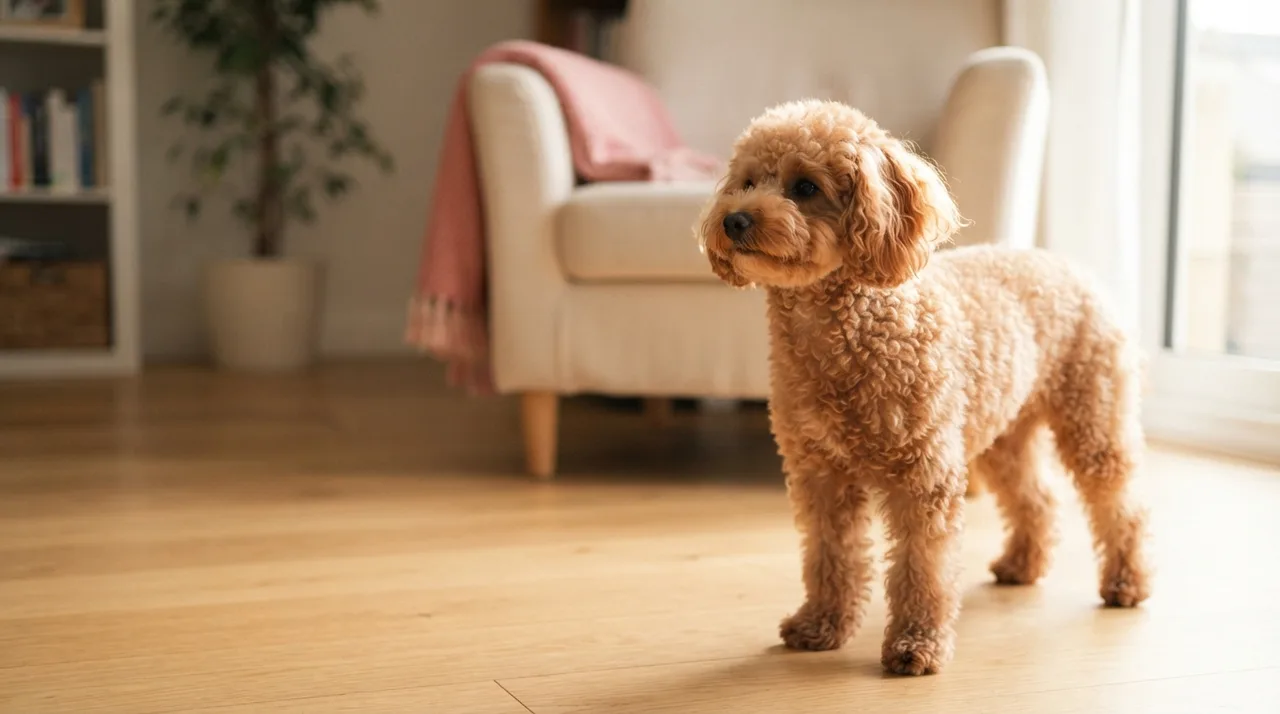
The Poodle is a purebred water dog from Germany, later refined in France, bred in three widely recognised sizes: Standard, Miniature and Toy. Its dense, curly coat grows continuously and sheds very little. It ranks second among all breeds for working intelligence, which makes it highly trainable and easily bored.
The Poodle at a glance
The Poodle dog breed comes in three size varieties, not three separate breeds. The Toy stands about 24 to 28cm and weighs 2 to 3kg, the Miniature 28 to 35cm and 5 to 7kg, and the Standard upwards of 38cm at 20 to 30kg. Lifespan is commonly cited at 12 to 16 years, with the smallest variety typically living longest.
Every size shares the same three defining traits: the curly continuously growing coat, the alert and busy temperament, and the grooming routine that comes with both. In Singapore, a Toy Poodle placed with a starter kit and support runs $3,488–$5,988 all-in at our shop; the wider licensed market sits at roughly $2,888 to $9,000 or more depending on what is included.
Poodle quick facts
- Sizes: Toy 2 to 3kg, Miniature 5 to 7kg, Standard 20 to 30kg
- Lifespan: commonly cited 12 to 16 years
- Coat: curly, continuously growing, very low shedding
- HDB: Toy and Miniature approved, Standard not approved
- Origin: Germany, refined in France, known as the Caniche
The three Poodle sizes, and which one fits a Singapore home
The three types of Poodle are the Toy, the Miniature and the Standard, and the size question is the one Singapore buyers get wrong most often. It also has a legal answer rather than a preference. HDB names "Poodle (Toy or Miniature)" as item 42 on its approved breed list, which means the Toy and the Miniature are the only two varieties a flat permits. The Standard is a large dog and is not approved.
Between the two approved sizes, the Toy is the predictable choice. A Miniature can mature at the upper end of its range and feel like a different dog in a two-room flat, whereas a Toy at 2 to 3kg stays genuinely flat-sized for life. We place Toy Poodles only, and our guide to the three Poodle sizes explained sets the measurements side by side.
Practitioner's note: people choose a size from photographs and then discover the grooming bill and the exercise need scale with it. Decide the size against your flat, your budget and your evenings, in that order.
Sizes, side by side
- Toy: 24 to 28cm, 2 to 3kg, HDB approved
- Miniature: 28 to 35cm, 5 to 7kg, HDB approved
- Standard: 38cm and up, 20 to 30kg, not HDB approved
- One approved dog per HDB flat
- Private residences may keep up to three dogs
Is a Standard Poodle allowed in an HDB flat?
No. The Standard Poodle is not on HDB's approved list, and no amount of good behaviour changes that. Keeping an unapproved dog in a flat can mean rehoming plus a fine of up to $4,000, which is why we say so plainly rather than letting a buyer find out later.
The Toy and Miniature are approved as item 42, and both still need the mandatory AVS licence and a microchip. If you want the rules in full, including how licensing transfers to an HDB address, read what HDB actually approves.
Where the Poodle came from, and why it was bred
The Poodle began as a German water retriever, bred to swim out and bring back downed birds, and was later refined in France into the dog the world now associates with Paris. Its French name, Caniche, comes from the word for duck dog. The elaborate show trim descends from a working clip that left the joints and chest insulated in cold water, not from fashion.
That working history explains more about the breed than the haircut suggests. A dog bred to problem-solve alongside a handler all morning does not switch off in a flat, which is where the modern reputation for restlessness comes from. The breed history traces the same line.
Poodle temperament: the thinking owner's dog
Poodle temperament is bright, alert and busy, and Poodle intelligence is the engine behind all three. The breed sits second only to the Border Collie for working intelligence, which shows up as fast recall, quick trick learning and genuine enjoyment of training sessions. It is affectionate and people-oriented, though more independent than the Poodle crosses that share half its parentage.
Honestly, the question I ask before recommending a Poodle is not who is home all day. That is the Cavapoo and Maltipoo question. The Poodle question is whether you can give this dog a job: ten minutes of training, a puzzle feeder, a walk with some thinking in it.
The same intelligence that makes a Poodle a joy makes a bored one inventive. Brains are a commitment, not a bragging right, and we would rather talk someone out of the breed than sell them the wrong dog.
Poodle temperament in short
- Second among all breeds for working intelligence
- Affectionate but more independent than the crosses
- Alert: it announces the door, the lift and the neighbour's cat
- Learns bad habits as fast as good ones
- Poodle exercise needs: daily walks plus thinking work
What are the pros and cons of a Poodle?
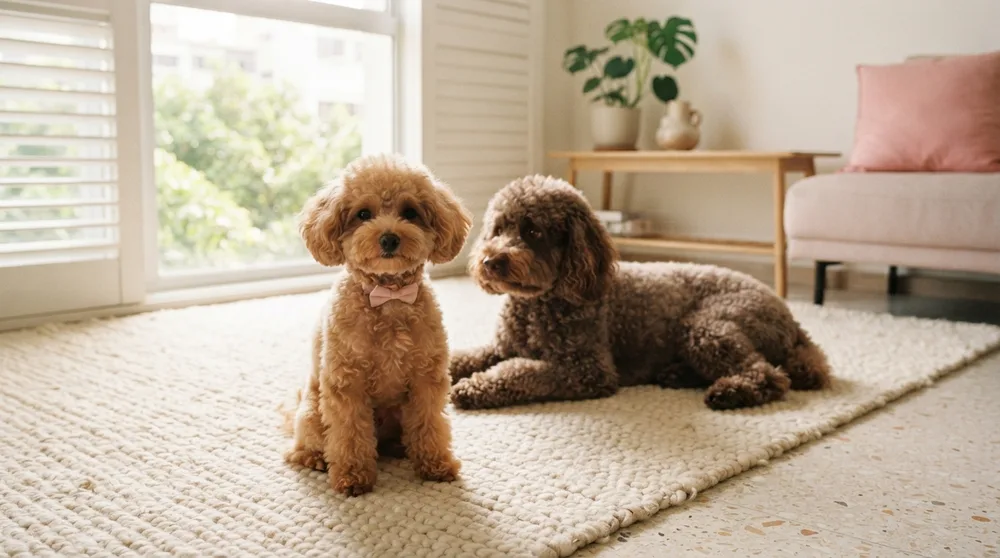
The Poodle is a low-shedding, long-lived, highly trainable companion that comes in a size for almost any home, and that is a genuinely strong set of pros. The cons are equally concrete: a coat that needs disciplined upkeep, a bark that goes off at the door, and a mind that finds trouble when it is under-used.
Nobody regrets a Poodle's intelligence. What catches people out is the grooming rhythm and the fact that a clever dog notices when the routine slips.
The honest balance
- Pro: very low shedding, suits allergy-conscious homes
- Pro: top-tier trainability and a long life
- Pro: three sizes, one of which is flat-sized
- Con: brushing several times a week plus a salon trim
- Con: alert barking and boredom behaviour if under-stimulated
What are the behavioral issues with Poodles?
The common Poodle behaviour problems are alert barking, chewing, digging at furnishings and separation anxiety when the dog is left alone all day. None of them are temperament faults. They are what an intelligent, attached dog does with unspent energy and an unpredictable routine.
Prevention is far easier than correction here. A Poodle with a fixed daily rhythm, some training built into it and something to solve rarely develops any of these habits in the first place.
The coat: what low-shedding actually means
A Poodle coat grows continuously instead of shedding out in seasons, which is why so little hair ends up on the sofa. That single trait is what makes this a low shedding dog breed rather than a non-shedding one. Low-shedding is not the same as allergen-free: dander and saliva still carry the proteins that trigger allergies, so the honest claim is less hair in the home, not an allergy-proof dog.
The shed hairs a Poodle does lose stay trapped in the curl rather than falling away. That is exactly what forms mats, and it is why brushing is maintenance rather than tidiness.
Puppy coat also clears into adult coat, usually settling a shade or two lighter than it started. The Toy Poodles we place are apricot, brown and red, all warm-toned, and a deep red puppy often matures softer than the photograph that sold it.
Grooming a Poodle in Singapore's humidity
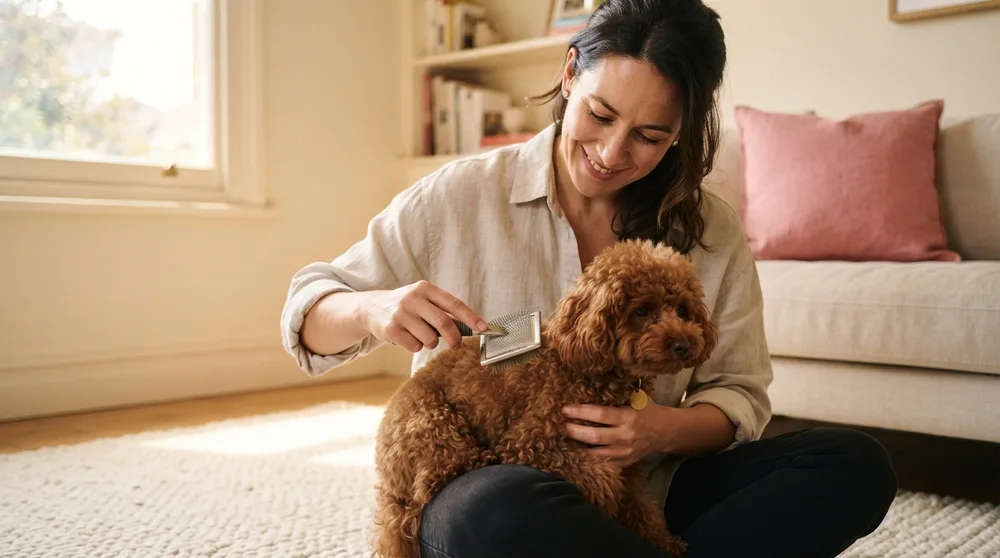
Grooming is the Poodle's real running cost, and Singapore compresses the timeline that overseas breed guides quote. Line-brush the whole coat two to four times a week, and check the friction zones behind the ears, under the collar and in the armpits daily. A salon trim every four to eight weeks keeps the coat workable, and local salons typically charge around $60 to $100 a visit.
Humidity does the damage between appointments, which is why Poodle matting is the most common complaint we hear locally. A coat that stays slightly damp after a walk mats faster than the same coat in a dry climate, which is why a missed fortnight here shows up sooner than the advice on an American breed page suggests. Our full routine, cut by cut, is in the guide to brushing and salon routine in detail.
A realistic grooming rhythm
- Line-brush 2 to 4 times a week, about ten minutes a session
- Check ears, collar line and armpits daily
- Salon trim every 4 to 8 weeks
- Budget roughly $60 to $100 a groom locally
- Short cuts buy time, they do not remove the routine
Poodle lifespan and the health conditions that matter
Poodle lifespan is commonly cited at 12 to 16 years, and the smaller the variety the longer the typical run. Sources vary, so treat any single figure with suspicion: the Knowledge Panel says 12 to 15, Wikipedia says 10 to 18 across all sizes. What is consistent is that this is a long commitment, not a short one.
The Poodle health conditions worth knowing in the Toy size specifically are patella luxation, progressive retinal atrophy and other eye conditions, dental disease, and Legg-Calve-Perthes. Dental care is the one owners plan for least and pay for most in small breeds.
Our answer to all of it is verification rather than alarm: every puppy is vet health-checked, vaccinated, dewormed and microchipped, and goes home with its records. You can read the detail on what a Toy Poodle costs all-in, including what the health side covers.
Vaccinations and when a Poodle puppy comes home
A Poodle puppy's core vaccinations fall at weeks 6, 8 and 12, with an optional fourth at week 16 if the vet advises it. Deworming happens at every one of those visits. The puppy goes home at about week 9, roughly a week after the second vaccination, and the booster runs annually from Year 1 onward.
Anyone quoting you a different schedule, or handing over a puppy without records, is worth a second look.
The puppy timeline
- Vaccinations: weeks 6, 8 and 12, optional 16
- Deworming at every vaccination visit
- Goes home at about week 9
- Annual booster from Year 1
- Microchip and records handed over at purchase
How much is a Poodle in Singapore?
A Poodle in Singapore costs roughly $2,888 to $9,000 or more at licensed shops, with colour, age and inclusions setting the figure. Our Toy Poodles are $3,488–$5,988 all-in, and all-in means the 30-item starter kit, free home delivery and playpen setup, a training lesson with an AVS-certified trainer, licensing completed at purchase and 5-day bring-back-if-sick support.
The sticker price is rarely the price. A bare puppy still needs a crate, a pen, bowls, bedding, a first groom and a licence, which is several hundred dollars arriving in the first fortnight. Compare what is included before comparing the number on the tag.
What a Poodle costs to keep, month by month
Grooming dominates the monthly figure for this breed, followed by food, preventives and the annual vet visit. The licence is the small, fixed part: $13.50 a year for a dog under 5 months, $81 a year above 5 months unsterilised, and $13.50 a year or a $35 one-time lifetime licence once sterilised. Full requirements sit on the AVS dog licensing page.
Across 12 to 16 years, the grooming line alone outgrows the purchase price. That is the number worth doing before the puppy, not after.
The recurring lines
- Grooming: the dominant monthly cost
- Food and preventives: steady and predictable
- Annual vet visit and booster
- Licence: $13.50 a year under 5 months
- Sterilised: $13.50 a year or $35 lifetime
Poodle or a Poodle cross? Why the Maltipoo and Cavapoo exist
The Poodle is the parent breed of both crosses Singapore buyers usually shortlist alongside it. The Maltipoo is Maltese crossed with Toy Poodle, the Cavapoo is Cavalier crossed with Poodle, and both were bred toward the Poodle's low-shedding coat with a softer, clingier temperament attached.
The difference is real and worth naming. The Poodle is the sharper-minded, more independent, more athletic parent with a tighter curl and a more disciplined grooming need. The crosses are gentler and far more velcro.
So if your household is out from morning to night, a cross is often the kinder answer, and we will say so. If you want a training partner, the Poodle is the one. The full comparison is in how the Poodle compares with the Maltipoo.
Which Poodle suits your household? A short decision guide
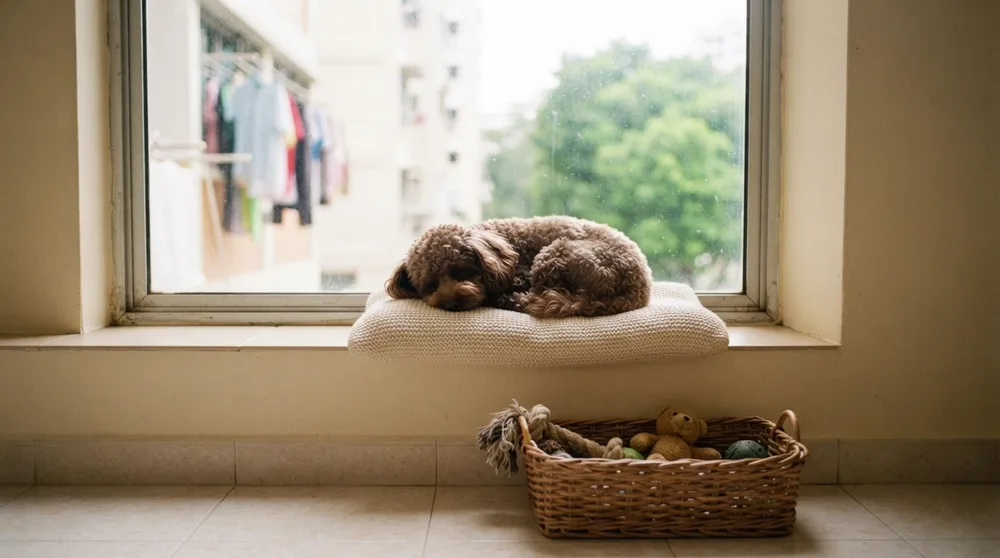
Match the dog to the life you actually live rather than the weekend version of it. Five questions settle it in most cases: can you give this dog a job, can you keep a brushing and salon routine, what does your home allow, how much dog experience do you have, and who is home during the day.
Three households, three honest answers. A working couple in an HDB flat with free evenings is a good Toy Poodle home. A family with school-age children can do well, though a 2 to 3kg Toy is fragile around toddlers who grab, so supervise handling. A first-time owner with time but no experience is fine, because this breed teaches easily, as long as the grooming routine is set up before the puppy arrives.
If, then
- HDB flat: Toy or Miniature only
- Want dog sports and training: Miniature or Standard, space allowing
- Empty flat all day: not this breed
- Want the look, softer character: consider a cross
- Tight grooming budget: plan the cadence first
"Teacup Poodle": what the label really means
Teacup is a marketing label, not a recognised size class. There is no fourth variety below Toy in any breed standard, and puppies bred deliberately for extreme smallness carry real health risk rather than premium value.
A Toy Poodle at 2 to 3kg is already a very small dog. We neither sell nor price anything as teacup, and a seller who does is telling you something about how they breed.
Where Singapore Poodles come from, and how to check a seller
Every legitimate shop in Singapore appears in the public registry of AVS licensed pet shops. Check the licence number in the registry rather than trusting the claim on the page, ours is AS24J00046. Unlicensed sellers still operate through classifieds and messaging apps, usually with puppies brought across the Causeway without veterinary care.
The risk sits with the buyer too, not only the seller. One buyer was fined $7,000 for buying a smuggled dog, and enforcement is tightening: smuggling cases fell 33% in 2025. The saving is illusory anyway, since a single parvovirus treatment can run past $5,000 with no guarantee the puppy survives.
Three checks before you pay
- The seller is listed in the AVS public registry
- Vaccination records exist and you can inspect them
- The microchip number matches those records
- Any one missing: walk away, whatever the price
- Curious Tails licence: AS24J00046
Purebred without paper certification: what that means
We place purebred Toy Poodles that are healthy, vet health-checked and microchipped, and that go home with vaccination records and breed identification. We do not provide or trade on paper certification, and for a companion dog that is a reasonable place to land.
What actually protects you is the vet health check, the vaccination record and the microchip, all three of which you can verify on the day. If you are buying for the show ring rather than the sofa, that is a different purchase and a different kind of seller.
Keep reading: the full Poodle guide library
About the authors
Written by Nelson and Kim
Nelson and Kim run Curious Tails, the AVS licensed pet shop (licence AS24J00046) behind Poodle.sg, at 2 Balestier Road #01-701, Singapore 320002. They have placed 100+ Toy Poodles with Singapore families and give every buyer their WhatsApp line for free care advice, for life. Everything on this page comes from that day-to-day experience, not from a content mill.
Frequently asked questions
Do Poodles bark a lot?
They are alert, so they announce the door, the lift and the neighbour's cat. A Poodle that is exercised and mentally occupied is quiet most of the day; a bored one is not. Training and enrichment fix it, scolding does not.
Do Poodles make good house dogs?
Yes. The coat sheds very little, the Toy and Miniature sizes suit flats, and the breed learns house rules quickly. The condition is engagement: a Poodle left with nothing to do will find its own job, usually a noisy or destructive one.
Are Poodles hypoallergenic?
They are very low-shedding rather than allergen-free. The coat grows continuously instead of dropping, so far less hair circulates, but dander and saliva still carry allergens. Allergy-prone households should meet a Poodle before committing.
How long do Poodles live?
Commonly cited at 12 to 16 years, with the smaller varieties typically living longest. Sources differ, so treat any single figure as an estimate. Either way it is a long commitment, and dental and eye care in the later years should be budgeted for.
How much is a Poodle in Singapore?
Roughly $2,888 to $9,000 or more at licensed shops, depending on colour, age and what is bundled. Ours are $3,488–$5,988 all-in, covering the 30-item starter kit, home delivery and setup, a training lesson, licensing and 5-day support.
Which Poodle size is HDB approved?
Toy and Miniature only. Both appear as item 42 on HDB's approved breed list. The Standard Poodle is not approved for flats, and keeping an unapproved dog can mean rehoming plus a fine of up to $4,000.
What are the pros and cons of a Poodle?
Pros: very low shedding, top-tier trainability, a long life and a size that fits a flat. Cons: brushing several times a week plus a salon trim every four to eight weeks, alert barking, and boredom behaviour if the dog is under-stimulated.
Is the Poodle a good family dog?
Yes, with a size caveat. Poodles are people-oriented, patient and quick to learn household rules. A Toy at 2 to 3kg is fragile around toddlers who grab, so supervise handling or consider a sturdier size while the children are very young.
Meet your Poodle
Come say hello at Balestier
2 Balestier Road #01-701, Singapore 320002 · Weekdays 12pm–6pm · Weekends 10am–6pm. Or message us first: tell us about your home and routine, and we'll tell you honestly if a Poodle fits.
If a Poodle sounds like your dog
We place purebred Toy Poodles from an AVS licensed shop, and we will tell you honestly if the breed is wrong for your household.
See available puppies