Puppy basics
How to stop a Toy Poodle puppy biting
Those needle-sharp teeth arrive right as your puppy comes home, around nine weeks old. Here is why a Toy Poodle mouths everything, and how to teach it that skin is off limits, using the quick brain that makes this breed such a fast study.
Nelson and Kim, Curious Tails · AVS licence AS24J00046 · 14 Jul 2026
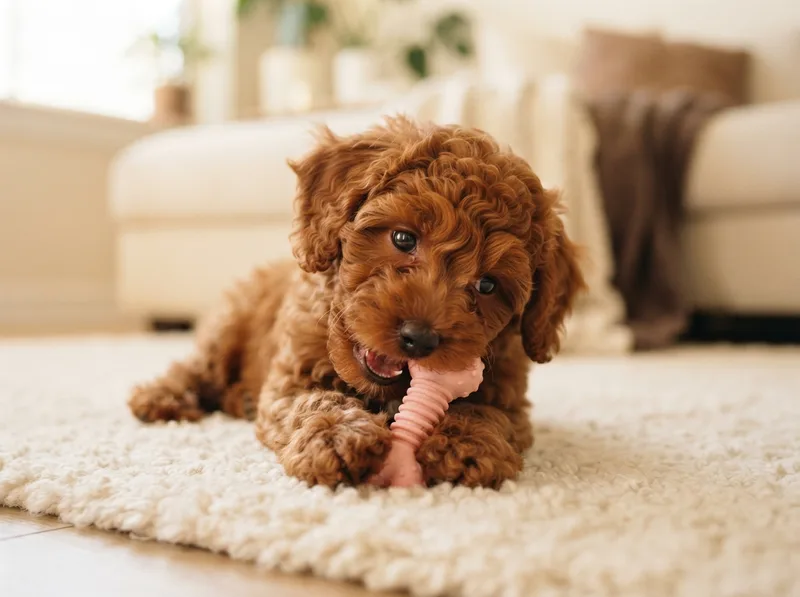
Why does my Toy Poodle puppy bite so much?
Puppies explore with their mouths, and from around twelve to sixteen weeks teething makes them want to chew constantly to ease sore gums. It is normal play, not aggression. Teach bite inhibition by ending play the moment teeth touch skin, then redirect every nip to a chew toy.
Teething or play? It is usually both
Both are happening at once, and neither is aggression. Teething sends a puppy hunting for anything to gnaw, while mouthing is simply how it played with its littermates. A new Toy Poodle owner almost always asks this in a mild panic, and the honest answer is that it is teething and normal, not temperament.
Watch for the over-tired nip. A puppy that turns into a little land shark in the evening is usually past ready for a nap, not being naughty, and a crate gives an over-tired puppy a place to settle faster than any telling-off.
Two reasons a puppy bites
- Teething: sore gums drive the chewing
- Play: mouthing is how puppies play
- Over-tired puppies nip the hardest
- A nap often ends a biting spell
- Neither one is aggression
How do I teach bite inhibition?
Make your skin end the fun. The instant teeth touch skin, give a soft yelp or a calm no, then stop playing for a moment. Puppies want the game to carry on, so learning that teeth end it is a powerful, gentle lesson.
Aim for a softer bite before a rarer one. First the puppy learns to use less pressure, then to mouth less often, and this soft-mouth training lands best before sixteen weeks. The second the mouthing stops, offer a chew toy so it knows what it is allowed to bite.
Teaching a soft mouth
- Teeth on skin ends the game
- Soft yelp or calm no, then pause
- Reward the moment biting stops
- Softer bite first, fewer bites next
- Teach it before sixteen weeks
Redirect every nip to a chew
Give the mouth somewhere legal to go. Redirection only registers if it happens within a second or two, so keep an appropriate chew toy within arm's reach in every room. The moment a nip lands, swap your hand for the toy.
A chilled chew earns its place during teething, because the cold soothes sore gums. Puppy-proof the cables, shoes and skirting boards too, since a teething Toy Poodle will find them if you leave the chance.
Redirect and soothe
- Swap hand for toy within seconds
- Keep chews within reach in every room
- Chill a chew to soothe sore gums
- Puppy-proof cables, shoes, skirting
- Every nip gets a legal target
What not to do
Never punish a puppy for teething. Smacking, tapping the nose or grabbing the muzzle teaches fear rather than a soft mouth, and it backfires hardest on a sensitive, clever breed like the Poodle.
Skip the rough hand play as well. Waving fingers as toys teaches the exact opposite of what you want, and a puppy cannot tell a hand from a chew when everyone at home plays by different rules. What we tell new owners is simple: pick one response and have the whole household use it, every single time.
When will my Toy Poodle stop biting?
Puppy biting is a teething phase with a predictable shape. It peaks at around twelve to sixteen weeks, runs most intense from four to six months, and eases as the adult teeth settle in by roughly six to seven months.
Age is only half the story. The consistency you keep through those months is what turns a nippy puppy into an adult with a polite mouth, so the routine you build now is the one that pays off later.
Teething timeline
- Nipping peaks at 12 to 16 weeks
- Chewing most intense at 4 to 6 months
- Adult teeth in by 6 to 7 months
- Consistency, not age, settles it
- The payoff is a polite adult mouth
Use the fast-learning brain to your advantage
A Toy Poodle learns a soft mouth faster than most puppies. This is widely ranked the second most trainable breed, often picking up a new cue in about five repetitions, so a clear, consistent rule about teeth sinks in quickly.
That speed cuts both ways. The same brain learns just as fast that teeth work if one person allows it, and a bored puppy chews and bites more, which is why a bored Poodle also barks more. Fold the soft-mouth lesson into short, reward-based training sessions, and message us on WhatsApp any time; every Toy Poodle puppy we place comes with a free first lesson from an AVS-certified trainer.
About the authors
Written by Nelson and Kim
Nelson and Kim run Curious Tails, the AVS licensed pet shop (licence AS24J00046) behind Poodle.sg, at 2 Balestier Road #01-701, Singapore 320002. They have placed 100+ Toy Poodles with Singapore families and give every buyer their WhatsApp line for free care advice, for life. Everything on this page comes from that day-to-day experience, not from a content mill.
Frequently asked questions
Is puppy biting a sign of aggression?
No. Puppies explore with their mouths and teethe, so mouthing and nipping are normal play, not aggression. Teach bite inhibition and redirect to chews, and it fades as the dog matures.
When do Toy Poodles stop biting?
Nipping usually peaks around twelve to sixteen weeks and settles as the adult teeth come in, generally by six to seven months. Consistency through teething decides it more than age alone.
How do I stop my Toy Poodle puppy biting my hands?
End play the instant teeth touch skin, with a soft yelp or calm no, then redirect to a chew toy within a second or two. Avoid rough hand play, and be consistent every single time.
Should I punish my puppy for biting?
No. Smacking, nose-tapping or muzzle-grabbing breeds fear rather than a soft mouth, and it backfires most on a sensitive, clever breed like the Poodle. Reward calm and redirect instead.
What can my teething Toy Poodle chew on?
Appropriate puppy chew toys, kept within reach in every room. A chilled chew soothes sore gums. Keep cables, shoes and small objects out of reach while the urge to chew is high.
Why does my Poodle puppy bite more in the evening?
That is usually an over-tired puppy at the witching hour, not naughtiness. A nap in a quiet crate often ends the spell faster than any correction.
Meet your Poodle
Come say hello at Balestier
2 Balestier Road #01-701, Singapore 320002 · Weekdays 12pm–6pm · Weekends 10am–6pm. Or message us first: tell us about your home and routine, and we'll tell you honestly if a Poodle fits.