Care
What to feed a Toy Poodle
A Toy Poodle is a small dog with a small stomach and, as a puppy, a fast metabolism. Feed it well and keep it lean, and you protect its joints, teeth and years with you.
Nelson and Kim, Curious Tails · AVS licence AS24J00046 · 14 Jul 2026
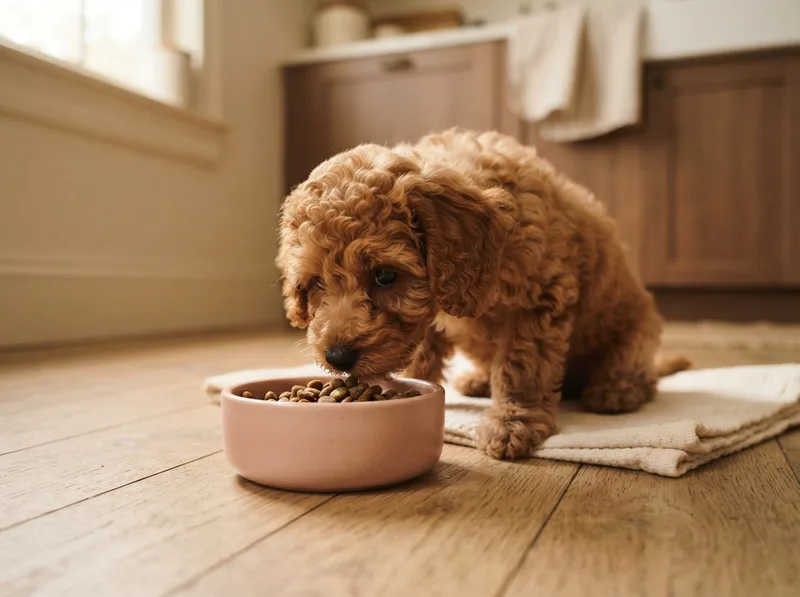
What is the best food for a Toy Poodle?
The best food for a Toy Poodle is a quality small-breed formula suited to its life stage, fed in the right portions and kept lean. Feed a puppy 3 to 4 small meals a day, then move to 2 meals as an adult. The brand matters less than portions and body condition, and anything medical belongs with your own vet.
How much and how often should you feed by age?
Feed a Toy Poodle by age: 3 to 4 small meals a day as a young puppy, dropping to 2 meals a day as an adult. A puppy has a tiny stomach and burns energy fast, so little and often keeps digestion settled and blood sugar steady. Around 10 to 12 months, when a Toy is largely grown, you can move to two measured meals.
The portion guide on the pack is your starting point. Find your dog's weight, a Toy is usually 2 to 3kg, and feed the amount listed for that weight and life stage. Then adjust to the dog in front of you rather than the bag, because two Poodles of the same weight can burn energy differently.
Measure every meal with a cup or a kitchen scale rather than eyeballing it. On a dog this small, an extra spoonful at each meal adds up quickly, and Toys are prone to putting on weight. Keeping fresh water down at all times matters just as much as the food.
Feeding by age
- Young puppy: 3 to 4 small meals a day
- Adult (about 10 to 12 months): 2 meals a day
- Follow the pack portion for the dog's weight
- Measure with a cup or scale, then adjust
- Fresh water always available
Why shouldn't a tiny puppy skip meals?
A very small Toy Poodle puppy can develop low blood sugar if it goes too long without eating, which is why regular small meals matter so much in the early weeks. Their reserves are tiny, so a missed meal has more effect than it would on a bigger dog. Sticking to set meal times is the simplest prevention there is.
Watch a young puppy for wobbliness, unusual flatness, or a sudden drop in energy, and speak to your vet if you see any of it. These signs ease as the puppy grows and its body stabilises, usually within the first few months. Until then, do not leave a small pup with an empty bowl for hours.
Keeping a small pup steady
- Do not let a tiny pup go too long between meals
- Keep to set meal times
- Watch for wobbliness or unusual flatness
- Speak to your vet if you see the signs
- This eases as the puppy grows
Should you keep the food your puppy came home on?
Keep your puppy on the food it came home with, at least for the first couple of weeks. A new home is already a big change for a small dog, and a sudden food swap on top of it is a common cause of an upset stomach during the settling-in week. Stay on the known food while everything else is new.
When you do want to change, switch gradually over 5 to 7 days. Start by mixing a little of the new food into the old, then shift the ratio a bit more each day until the bowl is all new. A slow change gives the gut time to adjust and avoids the loose stools that a sudden switch can bring.
Honestly, most new owners do not need a diet overhaul on day one. They need a simple routine and someone to call when unsure. We send our puppies home on a food they already know, so your first job is just to keep that going while your Poodle learns to settle into their first week at home.
Switching food safely
- Keep the same food for the first couple of weeks
- Change only once the puppy has settled
- Transition slowly over 5 to 7 days
- Mix a little new food into the old
- A sudden swap upsets a small stomach
From puppy to adult: when the diet changes
A Toy Poodle is largely grown by around 12 months, and that is the point to move from a puppy formula to an adult one. Puppy food is richer to fuel growth, so staying on it too long can pile on weight once your dog stops growing. Make the change the same gradual way, over about a week.
This is also when most Toys settle onto two measured meals a day. Reassess the portion as your dog matures, since activity, age and even the weather can shift how much it needs. An adult that has slowed down needs less than the bouncy young dog it used to be.
As your Poodle ages further, keep watching the waistline rather than the calendar. A senior may want a little less food and a gentler routine, but the same principles hold: quality food, measured portions, and a lean frame.
How do you keep an adult Toy Poodle lean?
Keep an adult Toy Poodle lean by feeding measured portions and checking the ribs, not by guessing. You should be able to feel the ribs easily under a light covering, with a visible waist when you look down. If you cannot feel them, it is time to trim the portion and cut back on extras.
Weight is the single biggest thing you control at the bowl. Extra kilos are hard on a small dog's joints and are linked to a shorter, less comfortable life, so a lean Poodle genuinely does better over the years. Toys gain weight easily, so weigh the food and treat the pack portion as a guide, not a rule.
None of this needs to be complicated. Feed to the dog, adjust when the ribs disappear or sharpen, and you are most of the way there. It is one of the simplest ways that keeping a small dog lean protects its lifespan.
A lean body condition
- Feel the ribs easily under a light covering
- Look for a visible waist from above
- Weigh food; the pack is a guide, not a rule
- Toys gain weight easily, so watch extras
- Lean dogs move better and live longer
Using treats for training without the extra calories
Treats are a training tool, not a food group, so keep them to roughly a tenth of daily calories and subtract them from meals. On a 2 to 3kg dog, a handful of training treats can quietly undo a careful diet, so use tiny, soft pieces and count them in.
Better still, train with part of the daily kibble ration itself. The Poodle is one of the brightest breeds and will happily work for its own food, which turns an ordinary meal into a job. This is the dog that wants a job, and food is your easiest way to give it one.
Puzzle feeders, a snuffle mat, and scatter feeding all do the same thing: they make your Poodle use its brain to eat. Ten minutes of that tires a clever dog more than another lap of the block. If you want a routine to build on, see how to turn mealtimes into training.
Smart treating
- Keep treats to about a tenth of daily calories
- Subtract treats from meals
- Use tiny, soft pieces for training
- Train with part of the daily kibble
- Puzzle feeders turn food into mental work
Can food cause your Poodle's tear stains?
Food can play a part in tear stains, though it is rarely the whole story. The reddish-brown marks below the eyes come from porphyrins, iron-rich pigments carried in tears, so a very iron-heavy diet or mineral-heavy tap water can make them more obvious on a pale or warm-toned face.
A clean, quality diet and filtered water can help, and so can simply wiping the face gently every day and keeping the hair around the eyes short and dry. Curly hair holds moisture against the skin, which is why a Toy Poodle stains more visibly than a smooth-coated dog. Good grooming often does more than any food change.
Do not chase a miracle food or a dramatic detox. If the staining is sudden, heavy, or comes with a red or sore eye, treat it as a vet conversation rather than a diet fad. For the coat side of it, our guide to a clean face and coat around the eyes covers the daily routine.
Help with tear stains
- Stains come from iron-rich porphyrins in tears
- Very iron-heavy diets can make them worse
- Try filtered water instead of tap
- Wipe the face daily; keep eye hair short
- Sudden or sore staining is a vet visit
Which foods should stay out of the bowl?
Several everyday foods are unsafe for dogs and should never reach a Toy Poodle. Keep chocolate, grapes and raisins, onion and garlic, xylitol (a sweetener in some gums and treats), and macadamia nuts well out of reach. On a small dog, even a little of these can do real harm.
Cooked bones, very fatty scraps, and heavily seasoned human food are also best avoided. Cooked bones can splinter, and rich or salty leftovers can upset a small stomach or, over time, unbalance a careful diet. Table scraps are where a lean Poodle quietly becomes an overweight one.
Keep a note of the toxic list somewhere handy in the kitchen. If your dog does swallow something on it, call a vet promptly rather than waiting to see what happens. Quick action matters far more than the amount looks like it should.
Keep these away
- Chocolate, grapes and raisins
- Onion, garlic and chives
- Xylitol sweetener and macadamia nuts
- Cooked bones and very fatty scraps
- Heavily seasoned or salty human food
Where can you buy Toy Poodle food in Singapore?
Small-breed dog food is easy to find in Singapore, stocked at local pet shops, vet clinics, and online stores that deliver. Look for a named meat as the first ingredient and a formula that suits your dog's life stage, and you have plenty of good options across a range of budgets.
In our humidity, buy smaller bags rather than a giant sack. Kibble loses its freshness and can spoil faster in the heat, so keep it sealed in an airtight container somewhere cool and dry, and use it within a reasonable window. It is a small habit that keeps every meal appetising for a sometimes-fussy Toy.
As Singapore's Toy Poodle specialists, we set new owners up with a starting food and a simple routine, and we stay reachable for the questions that come later. We are AVS licensed and based on Balestier Road, and we are happy to talk through feeding before and after you take a puppy home. If you are weighing up the wider commitment, read the real cost of feeding and caring for one, then message us on WhatsApp.
Buying and storing food here
- Stocked at pet shops, vet clinics and online
- Named meat as the first ingredient
- Buy smaller bags in our humidity
- Keep it airtight, cool and dry
- We set new owners up with a starting routine
About the authors
Written by Nelson and Kim
Nelson and Kim run Curious Tails, the AVS licensed pet shop (licence AS24J00046) behind Poodle.sg, at 2 Balestier Road #01-701, Singapore 320002. They have placed 100+ Toy Poodles with Singapore families and give every buyer their WhatsApp line for free care advice, for life. Everything on this page comes from that day-to-day experience, not from a content mill.
Frequently asked questions
What is the best food for a Toy Poodle?
A quality small-breed formula suited to the dog's life stage, with a named meat as the first ingredient and not too many fillers. The exact brand matters less than feeding the right portions and keeping the dog lean. Anything therapeutic or medical is a conversation for your own vet.
How much and how often should I feed a Toy Poodle?
Feed a young puppy 3 to 4 small meals a day because of its tiny stomach and fast metabolism, then move toward 2 meals a day from around 10 to 12 months. Follow the portion guide on the pack for your dog's weight, measure it with a cup or scale, and adjust to keep the dog lean.
Should I keep feeding the food my puppy came home on?
Yes, at first. A new home is already a big change, so staying on the same food for the first couple of weeks avoids adding an upset stomach. If you want to switch later, do it gradually over 5 to 7 days by mixing the old food into the new.
Can food cause tear stains on my Poodle?
Diet can play a part. Reddish stains come from porphyrins, iron-rich pigments in tears, and very iron-heavy diets or mineral-heavy tap water can make them more obvious. Filtered water, a clean quality diet and wiping the face daily can help, but persistent or sudden staining is worth a vet check.
How do I use treats without making my Toy Poodle overweight?
Keep treats to roughly a tenth of daily calories and subtract them from meals. Better still, train with part of the daily kibble ration; a clever breed like the Poodle will happily work for its own food, which turns feeding into mental exercise.
What foods should I never give a Poodle?
Keep chocolate, grapes and raisins, onion and garlic, xylitol and macadamia nuts well away, along with cooked bones, very fatty scraps and heavily seasoned human food. If your dog eats something on this list, call a vet promptly.
Why can't my Toy Poodle puppy skip meals?
Very small pups can develop low blood sugar if they go too long without eating, so regular small meals are the simplest prevention. Watch for wobbliness or unusual flatness and speak to your vet if you see it. This eases as the puppy grows.
Meet your Poodle
Come say hello at Balestier
2 Balestier Road #01-701, Singapore 320002 · Weekdays 12pm–6pm · Weekends 10am–6pm. Or message us first: tell us about your home and routine, and we'll tell you honestly if a Poodle fits.
Still deciding?
Read the price guide first: every dollar explained, no surprises at the shop.
See the price guide